Lirik Lagu Sinopsis Film Gaya Hidup
Blackberry LG Mobile Nokia Samsung Sony Ericsson
Klasemen L.Italia Klasemen L.Inggris Jadwal Liga Italia Jadwal Liga Inggris
Resto Enak di Jakarta Resto Romantis di Jkt Hokben Delivery Bakmi GM Delivery PHD - Pizza Hut
Showing posts with label Biology. Show all posts

10 of the Most Frightening Sea Monsters

Sea monsters are sea-dwelling mythical or legendary creatures, often believed to be of immense size.
Marine monsters can take many forms, including sea dragons, sea serpents, or multi-armed beasts. They can be slimy or scaly and are often pictured threatening ships or spouting jets of water. The definition of a "monster" is subjective, and some sea monsters may have been exaggerations of scientifically accepted creatures such as whales and types of giant and colossal squid.

Here's The top10 of the Most Frightening Sea Monsters
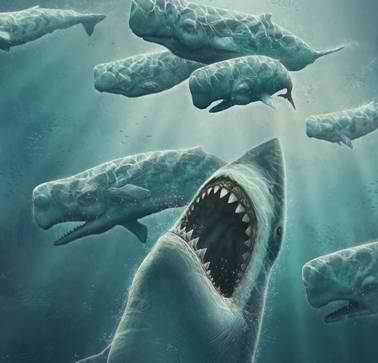
10 - Megalodon

Megalodon is probably the best-known creature in the list; it’s hard to keep the idea of a shark the size of a school bus out of pop culture. Plus, science-minded entertainment sources like the Discovery Channel love creatures that could pass for a movie monster. Despite the popular idea that Megalodon coexisted with dinosaurs, they lived from 25 to 1.5 million years ago, meaning that at best they missed the last dinosaur by 40 million years. On the other hand, this meant they might have still been around for the first humans. Eek.

Megalodons swam the warm oceans that were around until the last ice age in the early Pleistocene, which may have robbed them of their breeding grounds and food. Sometimes, it seems nature has our back.
9 - Liopleurodon

If Jurassic Park had an aquarium scene, and actually featured more animals from the Jurassic period, liopleurodon probably would have been in it. Although the actual length of these beasts is contested (some scientists have claimed lengths in excess of 50’), most agree that it was around 20 feet in length, with a full fifth of that being pointy-toothed head. When the mouth of the “smaller” estimate is still plenty large to eat you whole, I think that is perfectly huge enough.
Scientists have tested the paddle design of these creatures on small swimming robots and found that although they would not have been incredibly fast, they were incredibly agile. They also would have been able to make short, fast burst attacks like crocodiles, which in no way makes them any less intimidating
8 - Basilosaurus

Despite the name and appearance, that is not a reptile, but actually a whale (and not even the most fearsome on the list!) Basilosaurs were predatory ancestors of modern whales, and could be 50 to 85 feet long! It is described as being the closest a whale has ever come to being a snake because of how long and sinuous it was. Imagine swimming in the ocean with an 80+ foot long alligator-snake-whale. Now imagine being afraid to even take a bath ever again.
Physical evidence suggests that basilosaurus did not have the cognitive ability of modern whales, nor the ability to echolocate, and could only navigate in 2 dimensions (so no deep diving or breaching). So at least this monster whale was dumber than a bag of prehistoric hammers and could not chase you if you dove or scrambled out on dry land, probably forever.
7 - Jaekelopterus rhenaniae

Nothing about the words “sea scorpion” are comforting to begin with, so this should not come off as too awful: this was one of the two largest arthropods to have ever lived, reaching a length of over 8 feet of armored, clawed horror. Most of us freak out at the thought of inch-long ants and foot wide spiders, so it’s easy to imagine screaming like a little girl if you ever stumbled across a living one of these.
On the plus side, sea scorpions (Euripterids) have been extinct since before the dinosaurs, having been wiped out in the Permian Triassic extinction event (which killed 90% of all life on earth) and are only survived, to some degree, by horseshoe crabs, which are even less formidable than regular crabs. There is no evidence that any sea scorpions were actually venomous, but the structure of their tail is similar to a modern scorpion’s, so it might have been.
6 - Mauisaurus

Mauisaurus was named after the Maori god Maui, who pulled the islands of New Zealand up from the sea floor with a fish hook, so already you know this thing is going to be enormous. The neck of Mauisaurus measured up to 49 feet long; the longest proportionate (and really, “actual”) neck of any living thing aside from some sauropod dinosaurs. Their overall length was about 66 feet, and that ridiculously long neck had plenty of vertebrae, implying that it was flexible. Imagine a snake strung through a sea turtle with no shell, and you have an approximate idea of what this thing looked like.
It lived back in the Cretaceous era, meaning that creatures that jumped in the water avoid Velociraptors and Tyrannosaurs had to contend with these; the jury is out on which is worse. As far as science can tell, Mauisaurus was limited to the New Zealand area, showing that the area that would one day become Australia and its neighbors was always a land of terror.
5 - Dunkleosteus

Dunkleosteus was a 30 foot long carnivorous tank. It was outlasted by sharks, but I am sure that is small consolation for the variety of creatures this beast ate. Instead of teeth, it had bony ridges, like a turtle. It has been calculated that they had a bite force of 8,000 pounds per square inch, putting it on par with crocodiles and T-Rex in terms of being history’s strongest biters. They also believe, based on the evidence in the skull regarding its musculature, that it could have opened its mouth in one fiftieth of a second, meaning it vacuumed food into its guillotine of a mouth.
The plates that made up the “teeth” changed as the fish aged from a solid, rigid jaw to segments that allowed it to hold prey easier, and made it more effective in biting through the bony plate armor of other armored fish. In the arms race that was the prehistoric ocean, Dunleosteus was a predatory super tank.
4 - Kronosaurus

Kronosaurus is another short-necked pliosaur (like Liopleurodon up at number 9), and like Liopleurodon, its overall length has been contested. It was a “mere” 30 feet long and the longest teeth in its massive mouth were up to 11 inches long. This is why it was named after Cronus, the king of the old Greek Titans.
Guess where it lived? If you guessed “Australia”, then you have been paying attention to life (and are correct). The head was up to 9 feet long. They could eat an entire modern man whole, and still have room left over for half of another. It has also been suggested that since their flippers are so similar in design to those of modern sea turtles, that they may have crawled out onto land to lay eggs. You can be sure no one was digging up these thing’s nests to get at the eggs.
3 - Helicoprion

These sharks grew to be about 15 feet long, and had a lower jaw that was made of a “tooth whorl”. It looks like a cross between a circular saw and a shark, and when you mix apex predators with power tools, the world quakes in fear.
Helicoprion’s teeth were serrated, implying that they were definitely carnivores, but there is some debate as to whether their teeth were in the front of the mouth, as shown in the picture, or if they were farther back, which would suggest a softer diet, like jellyfish. However it was arranged, it clearly worked; Helicoprion survived the Permian Triassic extinction, which means they may have been smart enough to create bomb shelters. Or maybe they just lived in the deep sea.
2 - Livyatan melvillei

Remember me mentioning “hypercarnivorous” whales? Well here it is. Imagine a cross between an orca and a sperm whale. Livyatan melvillei was a whale that ate other whales. It had the largest teeth of any animal to ever use their teeth to eat (elephant tusks are bigger, but they just look impressive and help them smash things; they don’t eat with them) topping out at 1.18 feet. They lived in the same oceans and ate the same food as the Megalodon, so this whale actually had to compete with the largest predatory shark ever.
Not to mention their head was 10 feet long and featured the same echo-locating equipment as modern toothed whales, making them much more effective in murky water. In case it was not obvious, this beast was named after the leviathan, a giant sea monster from the bible, and Herman Melville, who wrote Moby Dick. If the great white whale had been one of these, it would have eaten the Pequot and everyone aboard as a snack.
1 - Giant Stingray

What grew 17 feet across, had a 10 inch poison spike in its tail and was strong enough to drag a boat filled with people? In this case, a prehistoric super-fish that is still lurking around in fresh and brackish waters from the Mekong river to northern Australia. Stingrays have been around since a few million years after the dinosaurs died out, and have proven to be a successful design, much like the sharks they descended from.
The giant stingrays use that tried and true ancient design, but have somehow managed to survive ice ages and even the catastrophic Toba event. They were featured on Animal Planet’s River Monsters, and despite the host’s tendency to exaggerate damn near everything, they are incredibly dangerous to fool around with, even if you don’t know you are fooling around with one. They are notorious for putting their neurotoxin covered spike completely through limbs. I guess, on the plus side, if there is one, at least they won’t try to eat you.
Read more

10 of World's Strongest Animals Compared to it's Body Weight

Meet the strongest animals in the wild. I found this article appealing... so I decided to add it in our list. thanks to nachocelebrity.blogspot.com for posting such great articles.

Here are the 10 of world's strongest animals.
10 - Grizzly Bear

The grizzly bear (Ursus arctos horribilis), also known as the silvertip bear or just the grizzly or North American brown bear, is a subspecies of brown bear (Ursus arctos) that generally lives in the uplands of western North America. This subspecies is thought to descend from Ussuri brown bears which crossed to Alaska from eastern Russia 100,000 years ago, though they did not move south until 13,000 years ago.
Grizzlies are normally solitary, active animals, but in coastal areas, the grizzly congregates alongside streams, lakes, rivers, and ponds during the salmon spawn. Every other year, females (sows) produce one to four young (commonly two) which are small and weigh only about 500 grams (one pound). A sow is protective of her offspring and will attack if she thinks she or her cubs are threatened.

They are strongest mountain animal, can lift 0,8 times their body weight. Their weight is 1500 pounds and can lift until 1200 pounds.
9 - Mussel

The common name mussel is used for members of several families of clams or bivalvia mollusca, from saltwater and freshwater habitats. These groups have in common a shell whose outline is elongated and asymmetrical compared with other edible clams, which are often more or less rounded or oval.
The word "mussel" is most frequently used to mean the edible bivalves of the marine family Mytilidae, most of which live on exposed shores in the intertidal zone, attached by means of their strong byssal threads ("beard") to a firm substrate. A few species (in the genus Bathymodiolus) have colonised hydrothermal vents associated with deep ocean ridges.
In most marine mussels the shell is longer than it is wide, being wedge-shaped or asymmetrical. The external colour of the shell is often dark blue, blackish, or brown, while the interior is silvery and somewhat nacreous.
The word "mussel" is also used for many freshwater bivalves, including the freshwater pearl mussels. Freshwater mussel species inhabit lakes, ponds, rivers, creeks, canals, grouped in a different subclass, despite some very superficial similarities in appearance.
Freshwater Zebra mussels and their relatives in the family Dreissenidae are not related to previously mentioned groups, even though they resemble many Mytilus species in shape, and live attached to rocks and other hard surfaces in a similar manner, using a byssus. They are classified with the Heterodonta, the taxonomic group which includes most of the bivalves commonly referred to as "clams".

They can hold something two times their body weight. Their shell is very strong, compared to their small body size.
8 - Anaconda

An anaconda is a large, non-venomous snake found in tropical South America. Although the name actually applies to a group of snakes, it is often used to refer only to one species in particular, the common or green anaconda, Eunectes murinus, which is one of the largest snakes in the world.

They can squeeze something same as their own body weight to death. Their weight can reach 550 pounds.
7 - Ox

An ox (plural oxen), also known as a bullock in Australia, New Zealand and India, is a bovine trained as a draft animal. Oxen are commonly castrated adult male cattle (castration makes the animals more tractable), but cows (adult females) or bulls (intact males) may also be used in some areas.
Oxen are used for plowing, for transport (pulling carts, hauling wagons and even riding), for threshing grain by trampling, and for powering machines that grind grain or supply irrigation among other purposes. Oxen may be also used to skid logs in forests, particularly in low-impact, select-cut logging.
Oxen are usually yoked in pairs. Light work such as carting household items on good roads might require just one pair, while for heavier work, further pairs would be added as necessary. A team used for a heavy load over difficult ground might exceed nine or ten pairs.

They can pull and carry something 1,5 times their body weight across rugged terrain. Their weight is 1300 pounds and can pull and carry until 2000 pounds.
6 - Tiger

The tiger (Panthera tigris), a member of the Felidae family, is the largest of the four "big cats" in the genus Panthera. The tiger is native to much of eastern and southern Asia, and is an apex predator and an obligate carnivore. The larger tiger subspecies are comparable in size to the biggest extinct felids, reaching up to 3.3 metres (11 ft) in total length, weighing up to 300 kilograms (660 pounds), and having canines up to 4 inches long. Aside from their great bulk and power, their most recognisable feature is a pattern of dark vertical stripes that overlays near-white to reddish-orange fur, with lighter underparts. The most numerous tiger subspecies is the Bengal tiger, while the largest is the Siberian tiger.

They can carry something two times their own body weight up a ten foot fence. Their weight is 600 pounds and can carry until 1200 pounds.
5 - Eagle

Eagles are members of the bird family Accipitridae, and belong to several genera which are not necessarily closely related to each other. Most of the more than 60 species occur in Eurasia and Africa. Outside this area, just two species (the Bald and Golden Eagles) can be found in the United States and Canada, nine more in Central and South America, and three in Australia.

They are the strongest bird. They can lift something four times their own body weight during flight.
4 - Gorilla

Gorillas are the largest species of primates. Gorillas are ground-dwelling, predominantly herbivorous apes that inhabit the forests of central Africa. Gorillas are divided into two species and either four or five subspecies. The DNA of gorillas is highly similar to that of a human, between 95 and 99% depending on what is counted, and they are the next closest living relatives to humans after the two chimpanzee species.

Gorillas' natural habitats cover tropical or subtropical forests in Africa. Although their range covers a small percentage of Africa, gorillas cover a wide range of elevations. The Mountain Gorilla inhabits the Albertine Rift montane cloud forests of the Virunga Volcanoes, ranging in altitude from 2,200–4,300 metres (7,200–14,100 ft). Lowland Gorillas live in dense forests and lowland swamps and marshes as low as sea level, with Western Lowland Gorillas living in Central West African countries and Eastern Lowland Gorillas living in the Democratic Republic of the Congo near its border with Rwanda.

They can lift something over 10 times their body weight. Their weight is 450 pounds and can lift up to 4600 pounds. Mean, they can lift as heavy as 30 adult humans.
3 - Leafcutter Ant

Leafcutter ants, a non-generic name, are any of 47 species of leaf-chewing ants belonging to the two genera Atta and Acromyrmex. These species of tropical, fungus-growing ants are all endemic to South and Central America and parts of the southern United States.
The Acromyrmex and Atta ants have much in common anatomically; however, the two can be identified by their external differences. Atta ants have 3 pairs of spines and a smooth exoskeleton on the upper surface of the thorax while Acromyrmex have 4 pairs and a rough exoskeleton.
Next to humans, leafcutter ants form the largest and most complex animal societies on Earth. In a few years, the central mound of their underground nests can grow to more than 30 metres (98 ft) across with smaller, radiating mounds extending out to a radius of 80 metres (260 ft), taking up 30 to 600 square metres (320 to 6,500 sq ft) and containing eight million individuals.

They can lift something 50 times their own body weight. Imagine a person who can lift a truck.
2 - Elephant

Elephants are large land mammals in two genera of the family Elephantidae: Elephas and Loxodonta. Three species of elephant are living today: the African bush elephant, the African forest elephant and the Asian elephant (also known as the Indian elephant). All other species and genera of Elephantidae are extinct, some since the last ice age although dwarf forms of mammoths may have survived as late as 2,000 BCE. Elephants and other Elephantidae were once classified with other thick-skinned animals in a now invalid order, Pachydermata.

Elephants are the largest land animals now living. The elephant's gestation period is 22 months, the longest of any land animal. At birth it is common for an elephant calf to weigh 120 kilograms (260 lb). They typically live for 50 to 70 years, but the oldest recorded elephant lived for 82 years.[3] The largest elephant ever recorded was shot in Angola in 1956. This male weighed about 24,000 lb (11,000 kg), with a shoulder height of 3.96 metres (13.0 ft), a metre (yard) taller than the average male African elephant. The smallest elephants, about the size of a calf or a large pig, were a prehistoric species that lived on the island of Crete during the Pleistocene epoch.

Elephants are a symbol of wisdom in Asian cultures and are famed for their memory and intelligence, where their intelligence level is thought to be equal to that of dolphins and primates. Aristotle once said the elephant was "the beast which passeth all others in wit and mind." The word "elephant" has its origins in the Greek ἐλέφας, meaning "ivory" or "elephant".
According to observations, healthy adult elephants have no natural predators,[15] although lions may take calves or weak individuals. They are, however, threatened by human intrusion and poaching.

They are the strongest mammals. Their weight is 12000 pounds and they can carry 20.000 pounds. They can carry as heavy as 130 adult humans.
1 - Rhinoceros Beetle

The rhinoceros beetles or rhino beetles are a subfamily (Dynastinae) of the scarab beetle family (Scarabaeidae). Other common names – some for particular groups of rhino beetles – are for example Hercules beetles, unicorn beetles or horn beetles. There are over 300 known species of rhino beetles.

Many rhino beetles are well-known for their bizarre shapes and large size. Famous species are for example the Atlas Beetle (Chalcosoma atlas), Common Rhinoceros Beetle (Xylotrupes ulysses), Elephant Beetle (Megasoma elephas), European Rhinoceros Beetle (Oryctes nasicornis), Hercules Beetle (Dynastes hercules), Japanese Rhinoceros Beetle or kabutomushi (Allomyrina dichotoma), Ox Beetle (Strategus aloeus) and the Unicorn Beetle (Dynastes tityus).

They are not only the strongest insect but also the strongest animal compared to body weight. They can lift something 850 times their own weight.
Read more

Top 10 of the World's Fastest Land Animals

If wild animals could participate in the Olympics, the land animals of the wild would outrun any human. Most animals use their speed when overpowering prey or escaping a predator.

The following maximum speed measurements "are based on measurements recorded over approximately quarter-mile distances. Exceptions are the lion, which was clocked in the act of charging, and the cheetah, which was measured over a 100-yard distance," notes the TravelAlmanac.com.
1 - Cheetah

The world's fasted land animal is the cheetah. The cheetah has an "acceleration that would leave most automobiles in the dust; a cheetah can go from 0 to 60 mph in only 3 seconds," according to the National Geographic. This large cat has exceptional eyesight to scan for prey. The sleek and flexible spotted body of a cheetah provides camouflage for dry grasslands in Southern and East Africa, where about 12,000 endangered wild cheetahs exist.


2 - Pronghorn Antelope

For more than a million years, the pronghorn antelope has roamed North America. "The running gait of the pronghorn is beautifully smooth and their powerful legs can carry them at a remarkable pace across the roughest kind of terrain. Pronghorns can reach speeds of 60 mph," notes the National Park Service.


3 - Lion

Lions roam grassy plains and open woodlands of the sub-Saharan region. Lions may be as long as 48 inches and weigh up to 500 pounds. When looking for prey the lion can reach speeds as fast as 50 mph.


4 - Thomson's Gazelle

The Thomson's gazelle roams the grasslands and open plains of northern Tanzania and southern Kenya. This gazelle weighs 35 to 55 pounds and is exceptionally alert to sounds and movements, and its fine sense of hearing, sight and smell balances its vulnerability on the open plains, according to the Out to Africa website. The Thomson's gazelle is able to run 50 mph.


5 - Wildebeest

The wildebeest belongs to the antelope family. The Afrikaans began calling the gnu the wildebeest because it had a shaggy mane, sharp horns, pointed beard and a huge head. Wildebeest can weigh as much as 600 pounds and run as fast as 50 mph. The wildebeest roams the woodlands and plains of sub-Saharan Africa.


6 - Springbok

A springbok may reach a speed of 50 mph. The springbok's main predators consist of leopards, lions, humans and lions. This reddish-brown, small antelope may leap up to 13 feet. This South African animal lives in semiarid and grassland regions.


7 - Quarter Horse

The quarter horse has heavy muscling, a stocky built and a compact appearance. This well-defined horse can sprint 47.5 mph. "Quarter horses are quick, balanced and agile. They are collected in action and stand at ease with their legs well under them. They are even-headed, kind, surefooted and steady," notes the Ultimate horse Site.


8 - Cape Hunting Dog

Identified by a distinctive coat of black, red, white and yellow, the Cape hunting dog reaches speeds of 45 mph. The Cape hunting dog travels in pack of six to 20 animals. A pack of these dogs may pursue large prey, such as antelope and wildebeest, especially if injured or sick.


9 - Elk

In North America, the elk is the largest deer. The wapiti is another name for the elk, which means "light-colored deer." The elk can go as fast as 45 mph when it needs to avoid danger. The elk is a massive animal; therefore most animals do not bother the elk. An elk's antlers may grow up to 4 feet, making the tip of the animal's horns as high as 9 feet off the ground.
10 - Coyote

The coyote runs up to 40 mph. Coyotes are able to adapt to North America's changing landscape. These clever animals eat rodents, fish, frogs, deer and snakes. With their keen sense of smell and strong vision, this member of the dog family typically forms a pack with other coyotes to hunt prey together in the fall and winter months.


Read more

10 Weirdest New Animals of 2010: Editors' Picks

Here are National Geographic's 10 Editors' Pick of weirdest newly discovered animals.
T. Rex Leech

A new leech king of the jungle, Tyrannobdella rex—or "tyrant leech king"—was discovered in the remote Peruvian Amazon, National Geographic News reported in April.

The up-to-three-inch-long (about seven-centimeter-long) leech has large teeth, like its dinosaur namesake Tyrannosaurus rex. What's more, the newfound critter's "naughty bits are rather small," noted study co-author Mark Siddall, curator of invertebrate zoology at the American Museum of Natural History in New York City.

For these reasons and more, the bizarre bloodsucker is an editors' pick for one of the oddest new species of 2010.
New Purple Octopus?

This unidentified purple octopus is one of 11 potentially new species found during a July deep-sea expedition off Canada's Atlantic coast.

The 20-day expedition aimed to uncover relationships between cold-water coral and other bottom-dwelling creatures in a pristine yet "alien" environment, according to the researchers' blog.
"Yoda Bat"

This tube-nosed fruit bat—which became a Web sensation as "Yoda bat"—is just one of the roughly 200 species encountered during two scientific expeditions to Papua New Guinea in 2009, scientists announced in October.

Though seen on previous expeditions, the bat has yet to be formally documented as a new species, or even named. Like other fruit bats, though, it disperses seeds from the fruit in its diet, perhaps making the flying mammal crucial to its tropical rain forest ecosystem.
"Ninja" Slug

Boasting a tail three times the length of its head, the newly described long-tailed slug is found only in the high mountains of the Malaysian part of Borneo, scientists said in April.

The new species shoots its mate with "love darts" made of calcium carbonate and spiked with hormones—hence its nickname: ninja slug. Scientists believe this Cupid-like behavior may increase reproductive success.
Sneezing Snub-Nosed Monkey

A new monkey species in Myanmar is so snub-nosed that rainfall is said to makes it sneeze—but that's apparently the least of its problems, conservationists announced in October.

The only scientifically observed specimen (pictured) had been killed by local hunters the time researchers found it—and was eaten soon after.
Wood-Eating Catfish

A new species of armored, wood-eating catfish (pictured underwater) found in the Amazon rain forest feeds on a fallen tree in the Santa Ana River in Peru in 2006.

Other so-called suckermouth armored catfish species use their unique teeth to scrape organic material from the surfaces of submerged wood. But the new, as yet unnamed, species is among the dozen or so catfish species known to actually ingest wood, National Geographic News reported in September.
The Simpsons Toad

Nosing around for "lost" amphibian species in western Colombia in September, scientists stumbled across three entirely new species—including this beaked toad.

"Its long, pointy, snoutlike nose reminds me of the nefarious villain Mr. Burns from The Simpsons television series," expedition leader Robin Moore said in a November statement.
Self-Cloning Lizard

You could call it the surprise du jour: A popular food on Vietnamese menus has turned out to be a lizard previously unknown to science, scientists said in November.

What's more, the newfound Leiolepis ngovantrii is no run-of-the-mill reptile—the all-female species reproduces via cloning, without the need for male lizards.
Squid Worm

Squid? Worm? Initially, this new species—with bristle-based "paddles" for swimming and tentacles on its head—so perplexed Census of Marine Life researchers that they threw in the towel and simply called it squidworm, National Geographic News reported in November.

Found via remotely operated vehicle about 1.7 miles (2.8 kilometers) under the Celebes Sea (see map) in 2007, the four-inch-long (ten-centimeter-long) creature turned out to be the first member of a new family in the Polychaeta class of segmented worms.
Pink Handfish

Using its fins to walk, rather than swim, along the ocean floor in an undated picture, the pink handfish is one of nine newly named species described in a scientific review of the handfish family released in May.

Only four specimens of the elusive four-inch (ten-centimeter) pink handfish have ever been found, and all of those were collected from areas around the city of Hobart (map), on the Australian island of Tasmania.
Read more
 
Copyright Onlinesing © 2010 - All right reserved - Using Blueceria Blogspot Theme
Best viewed with Mozilla, IE, Google Chrome and Opera.